
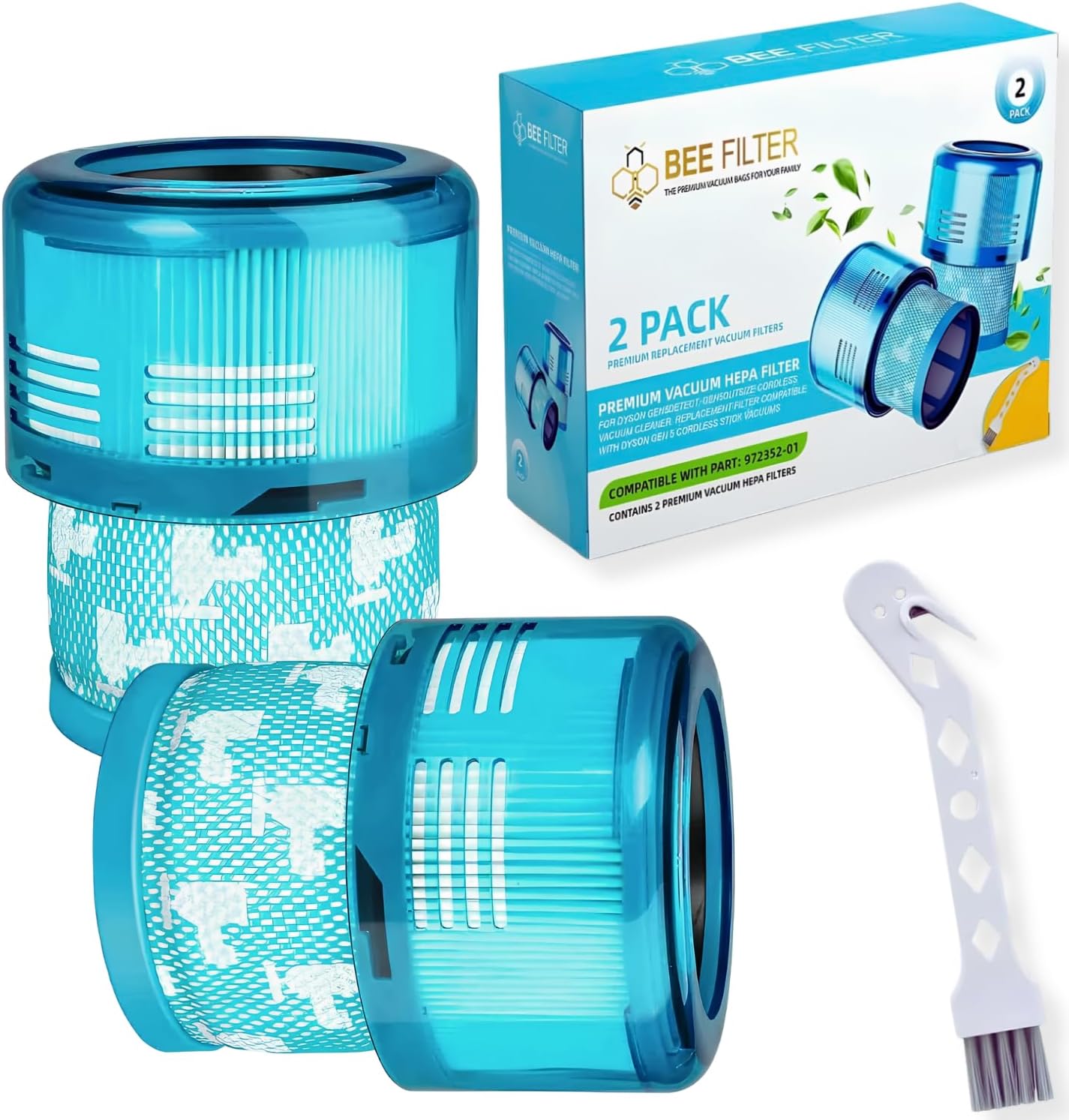
There is no useful one-size-fits-all shopping calendar for every Dyson filter and every household. A vacuum used for occasional touch-ups has a different maintenance history from one used throughout a busy home. More importantly, a damaged part and a dirty but intact part are different problems. Buying on a fixed schedule can distract from the checks that matter now.
Start with three possible outcomes: keep using an intact, correctly maintained filter; clean a washable filter according to its instructions; or replace an unsuitable or damaged part. If the vacuum has an unresolved fault, a fourth outcome may be necessary: investigate the machine before buying anything. This guide helps you separate those decisions.
Reusable HEPA H13 construction is a feature, not a fixed lifespan
Bee Filter describes its replacement filters as using premium HEPA H13 media, ABS housing and washable, reusable construction. The brand-stated up to 99.99% airborne-dust filtration figure concerns the media; no particle size or test method is supplied here, and it is not an independently tested whole-vacuum result. Reusability is a useful ownership feature while the assembly remains sound and can be maintained correctly. It does not set a guaranteed number of washes or remove the need to replace damaged media or a damaged housing. Use the actual condition and product instructions when deciding whether a filter can return to service.
Separate a reminder from a replacement rule
A reminder is an invitation to inspect. It can ask you to check condition, review recent use and consult the care instructions. It does not have to instruct you to throw the filter away. Avoid turning a seller’s general time estimate into a universal rule for every vacuum, usage pattern and filter construction.
Keep a simple history if you are uncertain. Record installation, cleaning and any unusual symptoms. The record is useful because it shows whether a concern appeared immediately after a change, gradually during ordinary use, or after a specific event. None of those patterns proves a diagnosis, but each gives you a better starting point than the filter’s age alone.
Inspect physical condition first
With the machine safely switched off as instructed, remove the filter using the prescribed method. Look at the housing, accessible seals and attachment features. A visibly split component, detached seal or broken locking feature deserves attention before the next use. Do not use tape, glue or extra force to make an uncertain filter fit.
Photograph suspected damage in good light. Include one view of the whole part and a close view of the problem. If the damage is ambiguous, send both to the seller or manufacturer. A support agent can work with a specific visible concern more easily than with a message saying that the filter looks old.
Distinguish a cleaning question from a buying question
Check the filter’s care instructions before assuming that accumulated debris means replacement. If it is a washable part and remains intact, the appropriate next step may be its specified cleaning process. Once maintenance is complete, reassess the original concern under the model’s instructions rather than evaluating only how bright the material looks.
Do not use repeated washing as a substitute for diagnosis. If you already followed the correct care process and the same machine symptom remains, pause and investigate other causes. Buying another filter immediately may be just as unhelpful as washing the same filter again without identifying what changed.
Use symptoms as clues, not verdicts
Dyson’s V15 support guidance identifies several possible contributors to poor performance, including the filter, tools, cyclone and selected power mode. That is why weak pickup alone cannot establish that a filter has reached the end of its life. The relevant model’s troubleshooting sequence should guide the next step.
| Observation | Useful next question |
|---|---|
| Visible housing damage | Should the part be removed from service and replaced? |
| A warning after a filter change | Was the correct item selected and fitted as instructed? |
| Reduced pickup with one attachment | Does that attachment need inspection? |
| Persistent concern after proper maintenance | What does the model’s troubleshooting process recommend? |
| A filter that merely looks discolored | Is there actual damage or a performance issue requiring investigation? |
The table is an investigation aid, not a diagnostic test. It deliberately avoids the shortcut of matching every symptom to a new purchase. If the machine emits smoke, has a burning smell or behaves in a way that appears unsafe, stop using it and seek appropriate manufacturer support.
Replace the correct part, not just a familiar shape
When replacement is appropriate, identify the machine before choosing the quantity or color. Compare its full model name with the listing’s supported models and exclusions. Use a part reference as an additional check, and compare the attachment arrangement shown in clear photographs. If these details disagree, resolve the mismatch before ordering.
In the Bee Filter catalog, B0DZN3F7F8 is a two-pack for the Gen5 family with reference 972352-01. B0FCF84HZF is an Outsize two-pack with reference 970422-01. Those are distinct choices. The familiar Dyson name or a similar cylindrical outline does not make them interchangeable.
Consider whether you need one replacement or a rotation
A replacement restores an item you can no longer use; a spare creates flexibility while another filter receives care. These are related but separate reasons to buy. If the present filter is intact and properly maintained, a second filter may be a convenience purchase rather than an urgent replacement.
Think about your household’s actual workflow. A home with one machine and predictable cleaning sessions may need a simple one-in-use, one-ready arrangement. Multiple vacuums require separate compatibility checks even if you buy a larger pack. Do not calculate value from the number of filters alone when some might not fit the intended machine.
Evaluate original and compatible replacements clearly
An original Dyson filter and a Bee Filter compatible replacement come from different brands. Compare the exact products rather than assuming that a lower price proves poor performance or that a familiar technical term proves equivalence. Look for clear model coverage, care instructions, identifiable seller support and evidence for any specific performance claim.
A rating for a complete vacuum should not automatically be assigned to a replacement filter installed later. Similarly, the word HEPA does not by itself tell you how a particular part was tested. Our original versus compatible Dyson filter guide provides a structured way to evaluate those distinctions.
A purchase checklist that prevents a second mistake
- Record the full vacuum model and any relevant part reference.
- Explain why you are replacing the current filter in one sentence.
- Check the listing’s exclusions, not only its headline compatibility claim.
- Verify the pack count and select the quantity that serves your workflow.
- Save the care instructions and order information where you can retrieve them.
- Inspect the replacement on arrival before discarding the packaging or old part.
On arrival, compare the new item’s attachment features with the intended fit and read its instructions. Do not force it into place to test a questionable match. If anything looks wrong, take photographs while the packaging and product identifier are still available. Resolving a selection issue before use is easier than describing it after several parts have been mixed together.
Keep a record that improves the next decision
A useful note can be as short as “replaced because the locking tab broke” or “bought a spare to cover maintenance time.” That record prevents convenience purchases from becoming evidence that every filter must be discarded at the same age. It also helps you explain recurring fit problems if the same issue appears again.
If your main concern is loss of pickup rather than visible filter damage, start with filter or blockage troubleshooting. If a message appeared immediately after washing, use the warning-after-cleaning guide. Choosing the right investigation can be more valuable than choosing the largest replacement pack.
Sources and further reading
Model-specific manufacturer instructions take priority. Product options refer to the Bee Filter catalog reviewed on October 16, 2026.