
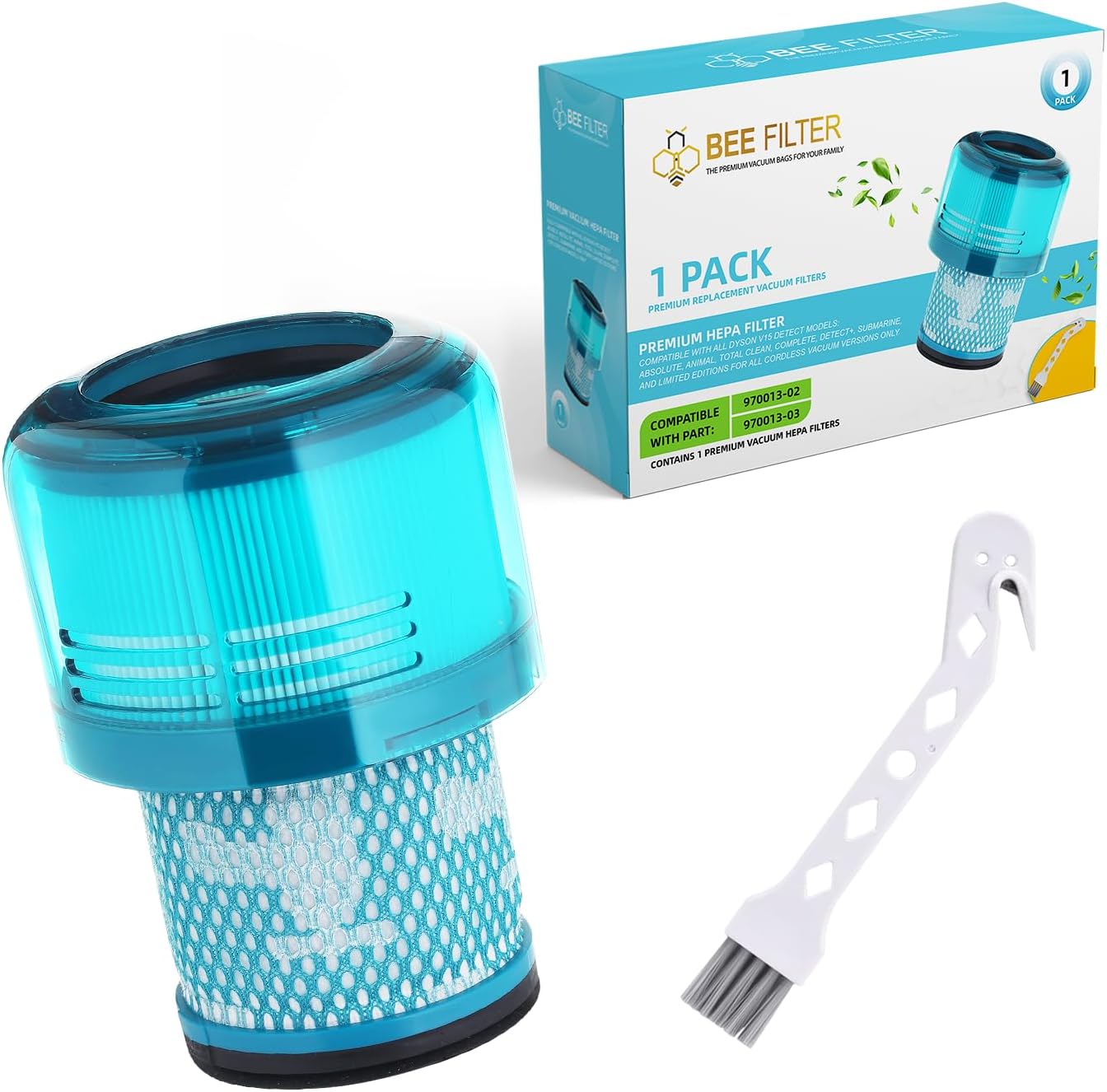
A larger replacement filter pack is useful only when the extra filters have a job to do. One buyer needs to replace a single damaged assembly. Another wants a dry spare while a washable filter completes its care cycle. A household with two matching machines may need a different quantity again. The right pack depends on those circumstances, not on the largest number printed on the listing.
Begin by verifying the exact vacuum model and the replacement’s supported-model list. A multi-pack contains multiple examples of the listed item; it does not broaden compatibility. Four filters intended for selected V15 and V11 machines do not become a mixed set for V12, Outsize and Gen5 vacuums. Once the application is clear, quantity becomes a straightforward planning decision.
The same material priorities apply to every pack size
Bee Filter specifies premium HEPA H13 media, ABS housing and washable, reusable construction for its replacement filters. Its brand-stated media specification includes up to 99.99% filtration of airborne dust. The percentage is supplied by the brand owner for the filter material, not as an independently verified figure for the complete vacuum, and no particle size or test method accompanies it here. Pack size changes the number of filters you receive; it does not, by itself, change that stated material specification.
This gives the pack decision a useful starting point. A single Bee Filter HEPA Filter can provide the specified material construction when you need one replacement. A two-pack provides a matching rotation partner. Three- and four-pack options provide additional assemblies for a planned reserve or other confirmed compatible machines. More filters in the box do not mean more filter layers in each assembly, a higher HEPA class or a stronger individual filtration claim.
Why washable construction changes the value calculation
With a washable, reusable replacement, each sound assembly can return to use after the correct care process and complete drying. The practical value of a spare is therefore partly about availability: you can give the recently washed filter the time it needs instead of treating drying as a deadline. This is especially convenient when vacuuming happens on several days each week, although the actual washing schedule must follow your product and machine instructions.
Do not multiply an assumed lifespan by the pack count to invent a saving. We do not specify a universal number of washes, a guaranteed period between replacements or a tested cost-per-year figure. Compare current delivered cost, the number you can use, and the usefulness of having a ready spare. A washable design may reduce the need to discard an otherwise serviceable filter after ordinary dust loading, but the filter must still be replaced if the housing or media becomes damaged.
Protect the premium construction while it is off the machine
The filter layers and ABS housing should both be cared for during storage. Keep a dry spare in a clean place where the media will not be crushed and the connection surfaces will not be knocked against other tools. Put washed filters in a separate drying location, and do not seal them in storage while damp. ABS construction does not make an assembly immune to damage, and HEPA H13 media is not an instruction to use harsh cleaning methods.
A larger pack works best when these small handling tasks are already organized. Assign each filter a role, keep the relevant care instructions with the set and label the storage location by machine model. Then the additional quantity supports the construction you chose instead of becoming a drawer of unidentifiable spares.
Give every filter a role before you buy
Write down how many suitable filters you currently own and whether each is usable. Count the installed filter, a completely dry spare and any unopened replacements separately. Exclude damaged parts or items whose identity you cannot confirm. Then describe the gap you want the purchase to fill: immediate replacement, a rotation partner, a reserve, or stock for another verified matching machine.
This small inventory prevents two common mistakes. You may discover that a two-pack supplies everything you need, even when a larger pack has an attractive unit price. Or you may realize that buying just one leaves no spare for a maintenance routine that regularly overlaps with cleaning time. The useful number is the one that closes a real gap in your setup.
What each pack size can be used for
| Pack | A practical reason to consider it | Question before ordering |
|---|---|---|
| One filter | Replace one assembly or add one spare to an existing set. | Do you already have a usable rotation partner? |
| Two filters | Create an installed-and-spare arrangement for one machine. | Will both filters be stored and maintained clearly? |
| Three filters | Add a reserve to a two-filter routine or supply verified matching machines. | What role does the third filter serve? |
| Four filters | Support several planned replacements or multiple machines with the same confirmed application. | Will every filter be useful before your needs change? |
When a single filter makes sense
A single replacement can be a focused purchase when you know precisely what is missing. You may already own a suitable spare and need to replace an assembly with a damaged housing. Or you may be testing whether a particular compatible product meets your fit and handling expectations before deciding how many future spares to keep.
For the listed standard V15/V11 application, Bee Filter’s blue single-filter option is one product to examine. Check its exact models and current order details. A single item is not automatically the cheapest route after delivery costs, but it can avoid paying for quantity you have no plan to use. Compare the final order total rather than assuming the smallest pack always has the smallest useful cost.
Why two filters can simplify a washing routine
A two-filter arrangement gives one filter a place in the machine and the other a clear role outside it. When the installed washable filter is due for care, a correctly matched, completely dry spare can be available. The practical benefit is scheduling flexibility. It does not change the cleaning or drying requirements of either filter, and it is not permission to reinstall an incompletely dried part.
Store the spare somewhere its identity and condition remain obvious. After washing, use a separate location for the drying filter so it cannot be confused with the ready-to-use spare. For the supported V15/V11 models, review the blue two-pack. Owners of other families should choose the corresponding model-specific page rather than borrowing this pack solely because the routine sounds suitable.
Give the third filter a specific purpose
Three filters can be convenient when you want a reserve beyond the ordinary installed-and-spare arrangement. The extra assembly may cover an accidental loss, a damaged part or another machine with the same verified application. Write that purpose down before ordering. If it has no distinct role, the third filter may simply become another object to identify and store.
Bee Filter’s blue V15/V11 three-pack should be evaluated as a quantity option within its own supported family. Do not infer a longer service life per individual filter because the pack contains three. If two family members use separate vacuums, establish that both machines appear on the supported list before sharing the pack between them.
Four filters require a plan for storage and use
A four-pack can suit a household with several clearly identified needs, but it also creates a small inventory. Decide which filter is installed, which is the spare and which remain unused reserves. Keep purchase details with the package so you can identify the product later. If the household upgrades to a different vacuum family, unused filters may no longer have an application.
The blue four-pack for listed V15/V11 machines is therefore best assessed by expected use rather than by quantity alone. A larger pack is not a universal recommendation for frequent cleaning. First consider whether your existing maintenance routine works, whether you have storage space and whether the additional filters will be used on confirmed compatible machines.
Calculate unit cost without inventing savings
Use the current total amount you would pay for each candidate order. Divide that amount by the count of filters included, using the same treatment of delivery and other charges for every option. The result is a useful comparison of purchase cost per filter. It is not a forecast of cost per year, because the usable period depends on factors not established by the pack count.
Now compare that figure with your actual need. If you need two filters and buy four, the lower unit price may still mean a larger immediate expense. Savings should be calculated against an alternative you would realistically buy, not against a hypothetical sequence of future purchases. Avoid assigning a fixed lifespan to each filter just to make the larger pack look better on paper.
Do not confuse quantity with grade, color or fit
A three-pack is a count, not a filtration classification. Blue and purple are appearance descriptors, not universal proof of performance. A part number is an identification aid, not a guarantee that every product using it has identical construction. Keep these facts in separate columns while comparing options so a favorable number in one column does not silently answer another question.
For a fuller explanation, read blue versus purple replacement filters and how to assess HEPA claims. Those guides help distinguish appearance and evidence from the simple question of how many filters arrive in a box.
Build a rotation that another person can follow
Use a storage note with the machine name, product reference and status of each filter. Plain labels such as installed, drying, clean spare and unopened are enough. Put the label on the storage location or packaging rather than on a sealing surface or filter medium. Anyone helping with the vacuum should be able to identify the ready spare without guessing from how recently an item was washed.
Keep different machine families in separate containers even if their filters look similar. Retain care instructions and check them whenever you change brands or product versions. The filter care guide can help organize your routine, but the instructions specific to the product determine how it should be cleaned and returned to service.
Choose the smallest pack that covers your actual plan
Count the verified machines, count the usable filters already available and assign a purpose to every extra filter. Compare the current total and unit costs, then decide whether the additional quantity is worth the storage and upfront expense. This approach works whether your answer is one replacement, a two-filter rotation or a larger reserve. The result is a pack chosen for your household rather than a quantity chosen by the listing.
Sources and further reading
Model-specific manufacturer instructions take priority. Product options refer to the Bee Filter catalog reviewed on October 16, 2026.