
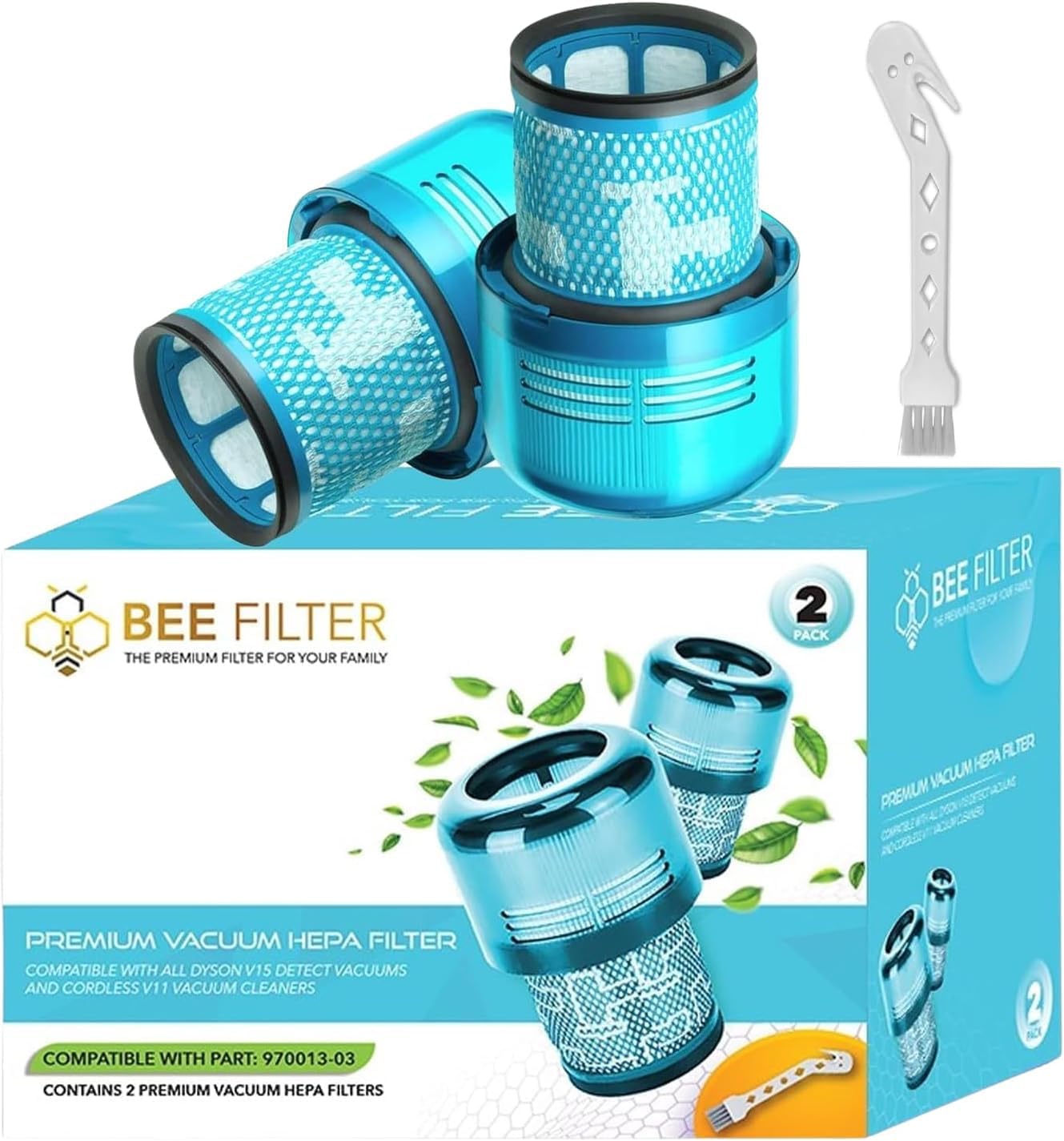
When blue and purple replacement filters appear next to each other in a search result, it is tempting to read the color as a technical label. One may look newer, closer to the original part or more premium in a photograph. Those impressions are not a reliable way to establish fit, filtration grade or the right application for your vacuum.
Use color as an appearance detail after identifying the exact model and product. There is no universal color rule in this guide that turns every blue filter into one performance class or every purple filter into another. Bee Filter offers color options across several product families, so the same color can appear on items intended for different machines.
Bee Filter’s premium material specification spans both colors
Across the Bee Filter replacement-filter range, the brand owner specifies premium HEPA H13 filter media, an ABS housing and washable, reusable construction. The media carries a brand-stated up to 99.99% airborne-dust filtration figure. This is the supplied material specification, not an independent test result for a complete Dyson vacuum, and no particle size or test method is supplied with the figure here. Blue and purple should therefore be compared as available appearances within the correct model family, not as an automatic low-grade versus high-grade choice.
That is useful when choosing between two otherwise suitable listings. If both exact products list your machine, the same stated H13 material features do not require you to choose a particular color. You can consider the pack quantity, current delivered price, included accessories and the appearance you prefer. Do not invent a filtration advantage for blue or purple, and do not assume a color difference proves a different number of filter layers.
Look beyond the cap to the construction details
The filtration layers provide the working media, while the ABS housing supports the assembly and provides its handling and connection surfaces. These are more useful construction details than an inference from the cap color. A photograph can help you recognize the general shape and inspect what arrives, but the written product specification is where the material information belongs. No universal layer count or comparative durability rating is supplied for the color options in this guide.
When unpacking, inspect the media and housing together. Look for visible damage, a crushed section, a cracked connection or a shape that differs from the correct product. A premium HEPA H13 material specification is a reason to consider the product; it is not a reason to overlook damage or an uncertain fit. Keep the ASIN and machine model with the spare so the next order identifies the same application reliably.
Choose a color you like, then use the same careful washing routine
Bee Filter describes these replacement filters as washable and reusable. That benefit applies to a sound, correctly maintained filter, whichever listed color you choose. Follow the supplied instructions, handle the filtration layers gently and wait until the assembly is completely dry before reinstalling it. Color does not tell you whether it is dry, how many washing cycles remain or whether the housing is undamaged.
For a blue-and-purple rotation on a confirmed compatible machine, label the storage places by status rather than permanently treating one color as clean. Each filter will alternate between installed, washing, drying and ready. The result is a convenient routine built around the same stated premium materials, with color used as a helpful visual detail instead of an unsupported performance ranking.
Three separate questions hidden in a color comparison
The first question is compatibility: does this exact replacement list your machine? The second is product specification: what does the seller actually document about this item? The third is appearance: which color do you prefer or find easier to organize? Keeping those questions separate stops a visually attractive answer from becoming an unsupported technical conclusion.
For example, two blue filters can belong to different machine families, while a blue and a purple option may both be listed for the same application. Neither observation means they have identical measured performance. It means color is insufficient for making either determination. You still need the product reference, supported-model information and any evidence relevant to the claim being compared.
Examples from Bee Filter’s catalog
| Application to verify | Blue example | Purple example |
|---|---|---|
| Listed standard V15/V11 models | B0CBPR1QQK, two filters | B0CBHHKJXG, two filters |
| Listed V12 Detect Slim models | B0DSZF1N42, two filters | B0HBJNJXQJ, two filters |
| Listed Outsize/V11 Outsize models | B0H1MYJCTK, two filters | B0FCF84HZF, two filters |
This table shows where to begin comparing color variants; it is not a substitute for each product’s compatibility details. A blue V12 item is not interchangeable with a blue V15/V11 item merely because the photograph has a similar cap. Likewise, the word Outsize requires its own model check rather than being treated as an extension of every V11 or Gen5 product.
Use a part reference to narrow the search
Dyson’s original-part pages provide concrete identification examples: 971517-01 is listed for specified V12 Detect Slim machines, while 970422-01 is listed for specified Outsize machines. Those references help organize a search more precisely than blue filter or purple filter. For a compatible purchase, cross-check the replacement page’s own supported-model list as well.
Write the reference next to the full vacuum name and keep it visible while browsing. A seller’s comparison reference identifies an intended replacement application; it does not make the item genuine Dyson or prove performance equivalence. Our part number guide explains how to keep the vacuum name, original part number and ASIN distinct.
What product photographs can help you check
Good photographs can show the general assembly, the attachment end, the overall proportions and what is included in the package. Use them to spot obvious discrepancies and formulate a specific question. If your existing filter looks substantially different at the connection, investigate before ordering rather than relying on a short compatibility phrase.
Images cannot, on their own, prove material grade, particle capture efficiency or the exact dimensions of a component. Perspective can also make two objects look more alike than they are. Treat a photograph as a useful view of the listed item, then use the written specifications and fit information to complete the check. A color match is weaker evidence than a verified model match.
Why an original filter’s color rule may not transfer
A manufacturer may use colors to distinguish particular products in its own range. That does not create an automatic coding system for every compatible brand, every model family or every market. When you see a discussion explaining a color difference between two specific original parts, preserve the context: it concerns those named products, not all similarly colored replacements.
For Bee Filter, identify the exact ASIN and read its description. Do not borrow a claim from another brand because the casing looks similar. This is especially important when a comparison connects color with HEPA terminology or a numerical filtration claim. The evidence must belong to the item being purchased, regardless of whether its appearance resembles a well-known original part.
Do not infer a filtration grade from the housing
A blue housing does not establish H13 or H14, and a purple housing does not establish the absence of a particular grade. The appropriate question is whether product-specific documentation supports the stated filtration characteristic. Without that documentation, this guide does not rank the colors by capture performance.
Ask for the identity of the tested product and the applicable report when a particular filtration level matters to you. A material certificate, a complete-assembly report and a whole-vacuum claim are different pieces of information. Read HEPA vacuum filter claims explained for a practical way to examine them without treating a bold label as a complete technical answer.
Compare like-for-like quantities and order terms
Before deciding that one color is more expensive, make sure both offers contain the same number of filters and relate to the same supported application. A two-pack next to a three-pack can create a misleading visual comparison. Check the actual item code and count rather than relying on a main image that may show a family of available options.
Use the current total amount you would pay and calculate cost per included filter if that helps. A price difference does not establish a performance difference. It may reflect the specific offer, pack or selling conditions, and the explanation should come from the product information rather than from an assumption about color. The pack size guide helps turn quantity into a practical household decision.
When color can be genuinely useful
After both items have been verified for their intended use, color can be a convenient organizational cue. A household might prefer one appearance for a particular machine’s supplies or use a storage label that includes the color to make the right box easier to find. The cue should support a written identification system, not replace it.
For a filter rotation, label locations by status such as clean spare and drying. Color alone is not a reliable status label because the same filter changes status during the care cycle. A blue filter can be wet just as a purple one can be dry. Make the storage arrangement clear enough that another person can select a ready filter without knowing the history of the last wash.
What to do if your original filter is a different color
Do not reject or accept the replacement solely on that difference. Return to the complete machine identity, the original reference and the candidate item’s supported list. Compare the listed connection and shape details, and ask a focused fit question if something remains unclear. The useful question is whether the specific product is intended for the specific machine.
Send the ASIN, the full model name and a clear photograph of the existing filter’s attachment end. Mention that the color differs, but do not let that become the only detail in the message. Written confirmation should address the application directly. Once that point is resolved, you can make an appearance preference without confusing it with a technical requirement.
A simple order for making the choice
First identify your vacuum. Next locate the relevant filter reference and the candidate product’s exact compatibility information. Then review the documented characteristics, quantity and current order terms. Finally choose the appearance you prefer among the suitable options. This sequence preserves the useful visual role of blue and purple while keeping fit and performance tied to the information that can actually establish them.
If you are also deciding between an original-brand part and a compatible product, read genuine versus compatible Dyson filters. That decision adds questions about product origin, documentation and support, but the starting principle is the same: compare identified products for your machine, rather than comparing colors in isolation.
Sources and further reading
Model-specific manufacturer instructions take priority. Product options refer to the Bee Filter catalog reviewed on October 16, 2026.