
A filter drying on the counter creates an awkward question: can you use the vacuum now, or should you wait? The answer cannot come from a countdown alone. The drying instruction sets a minimum waiting period; the condition of the filter decides whether it is ready. If your next cleaning job is urgent, a suitable dry spare is a planning solution. Cutting the drying period short is not.
Dyson’s filter-care page specifies at least 24 hours in a well-ventilated location and complete dryness before reinstallation. It also warns against drying in a tumble dryer, microwave or near a flame. Follow your specific model’s care instructions and any instructions supplied with your replacement filter.
Why “24 hours” is not a guaranteed finish time
Imagine two households washing a filter at noon. One leaves it in an open, suitable drying area; the other places it in a crowded corner with little space around it. Even though both clocks reach noon the next day, the environments are not identical. That example is a planning illustration, not a measurement of either household’s drying time.
The useful distinction is between an earliest inspection time and permission to reinstall. Put the first in your calendar. Make the second depend on the filter being ready under the relevant instructions. Avoid creating a deadline such as “must vacuum at noon tomorrow” that pressures you to treat the minimum as a promise.
Create a drying location with a clear purpose
Choose the location before you wash the filter. It should be somewhere the part can remain undisturbed, away from the vacuum’s electrical components and ordinary kitchen splashes. Follow the required orientation for your filter. Keep enough surrounding space that the part is not buried among bags, towels or other household items.
Do not put a washed filter into its storage bag because it looks tidy there. Storage and drying serve different purposes. A storage space keeps a ready spare identifiable and protected; a drying area makes it clear that the washed part has not yet returned to service. Keeping those locations separate is particularly helpful if children or other adults might reassemble the vacuum.
Write down the time you actually finished washing
A short note removes guesswork. Record the finish time, model and which filter you washed. “Tuesday evening” is easy to misremember as Tuesday afternoon. An exact time also helps when you contact support about a warning that appeared after cleaning: you can describe what happened without reconstructing the schedule from memory.
| Record | Example entry | Why it helps |
|---|---|---|
| Filter identity | V12 spare A | Keeps different models apart |
| Wash completed | Tuesday, 7:30 p.m. | Provides a clear starting point |
| First check | After the stated minimum | Avoids premature refitting |
| Returned to service | Record after checking readiness | Separates elapsed time from condition |
These entries are examples of an organizational method, not an extra maintenance specification. You do not need an app or a detailed spreadsheet. A card near the drying area can do the same job without adding another household chore.
Do not rely on one reassuring surface
A quick glance at the outer housing is not a complete readiness check. Follow the model’s inspection guidance and check accessible areas carefully. If you are unsure whether the part is fully dry, continue waiting. There is no benefit in treating uncertainty as evidence that the filter is ready.
Avoid invasive experiments to prove dryness. Do not dismantle bonded filter materials, insert tools into the media or bend the housing to inspect an inaccessible area. If you cannot determine whether the item is suitable for reinstallation, ask the manufacturer or seller using the exact part details. A clear photograph and wash timeline are more useful than a description such as “it seems fine.”
Plan around a spare instead of accelerating the process
A dry, correctly matched spare lets you separate washing from the next cleaning job. Check the spare before starting: it must be the intended part for the machine, physically sound and ready for use. A new filter for a different model is not a substitute just because it is unused.
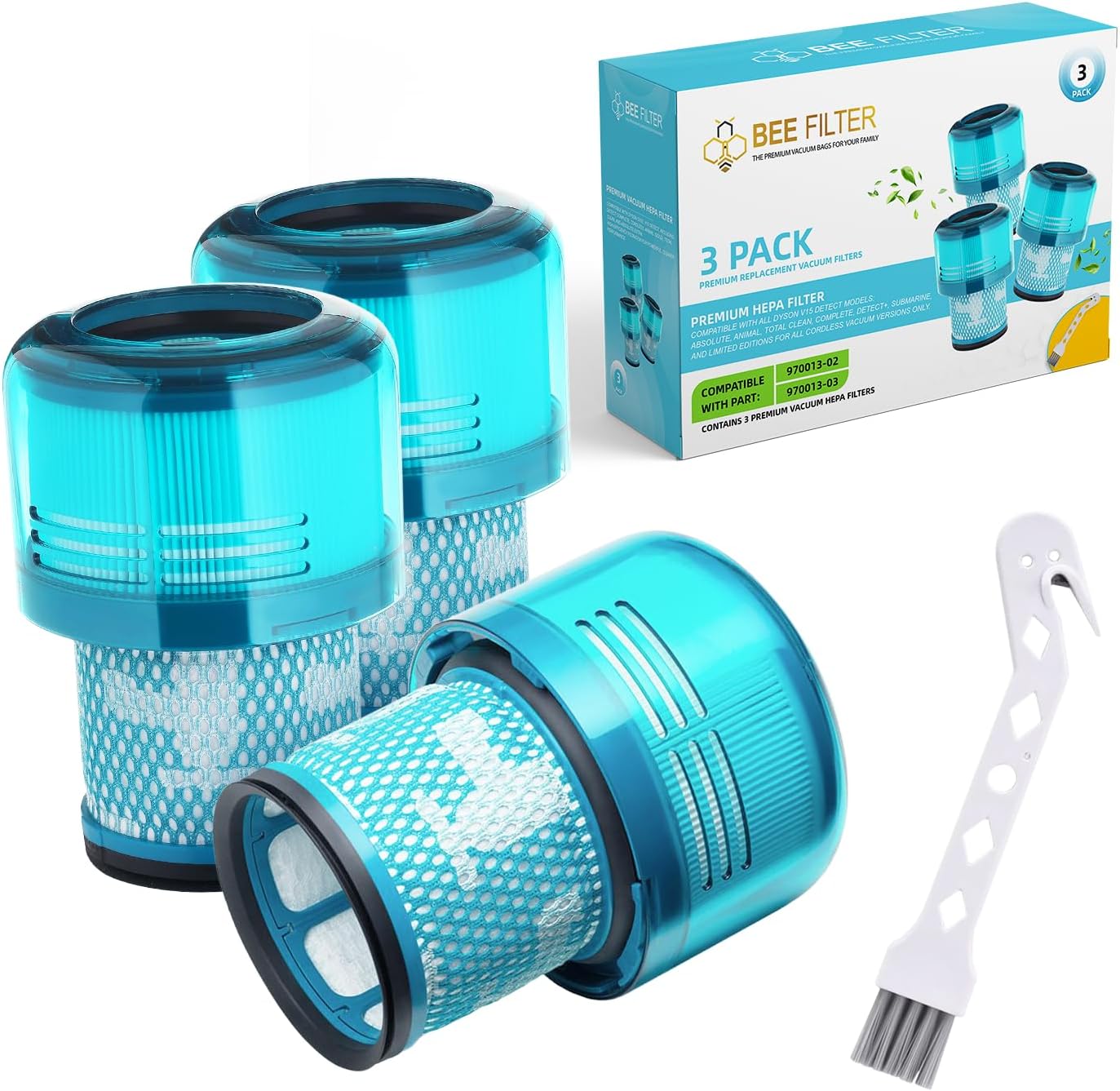
Bee Filter’s B0CBPKBVLR three-pack is listed for selected V15 and V11 machines. The B0DSZJ99T1 three-pack is listed for V12 models. Pack quantity helps organize a rotation, but those two listings should not be mixed into a shared pile of “Dyson spares.” Read each compatibility list before choosing the pack.
For one vacuum, a simple sequence is to have a ready filter available, remove the filter due for care, follow its cleaning instructions, and return it to the ready-spare area only after checking it. That sequence gives the drying part time without making the rest of the household remember which of several loose filters is wet.
What if you need to vacuum before the filter is ready?
Decide whether the job can wait, whether you have a verified dry spare, or whether another suitable cleaning tool can handle the immediate task. Do not run the vacuum without its required filter to get around the delay. Also avoid taking a filter from another family simply because its outline looks similar.
If a spill or unexpected mess caused the urgency, first establish whether your vacuum is intended for that material. The desire to finish quickly should not turn a filter-care question into an unrelated misuse of the machine. Follow the machine’s permitted-use instructions and use an appropriate method for the task.
Handle an accidental early installation methodically
If you realize that you reinstalled a filter before confirming it was dry, stop using the machine. Remove power as instructed and consult the model’s support guidance. Tell support whether the vacuum was switched on, whether a warning appeared and how long ago the filter was washed. Do not keep running the machine to see whether the symptom disappears.
This is a different situation from merely finding a damp filter on a shelf. It may need machine-specific advice, and a new filter purchase does not establish that the machine itself is unaffected. Keep the decision about drying separate from any diagnosis of what happened during operation.
A weekly household plan without a false deadline
Suppose your main cleaning session is Saturday morning. Inspect the spare and plan maintenance after an earlier session, leaving enough flexibility for the washed part to remain out of service if necessary. The important change is not picking a magic day. It is removing the expectation that washing and immediate reuse belong in the same short task.
If you share the vacuum, tell the next user where the ready spare is stored and where the unfinished filter is drying. Include the machine model on each storage container. In a home with a V12 and an Outsize, “the spare on the shelf” is too vague to prevent a mix-up.
Questions to answer before refitting
- Have I allowed the minimum period stated for this filter?
- Have I followed the required drying position and checked readiness as instructed?
- Is this definitely the correct filter for the machine in front of me?
- Is there any visible damage or unresolved uncertainty?
- Will everyone using the vacuum understand that this part has now returned to service?
For the complete preparation routine, read how to wash a Dyson vacuum filter. If a message remains after maintenance, use the post-cleaning warning checklist rather than assuming that the solution is another rinse.
Sources and further reading
Model-specific manufacturer instructions take priority. Product options refer to the Bee Filter catalog reviewed on October 16, 2026.