
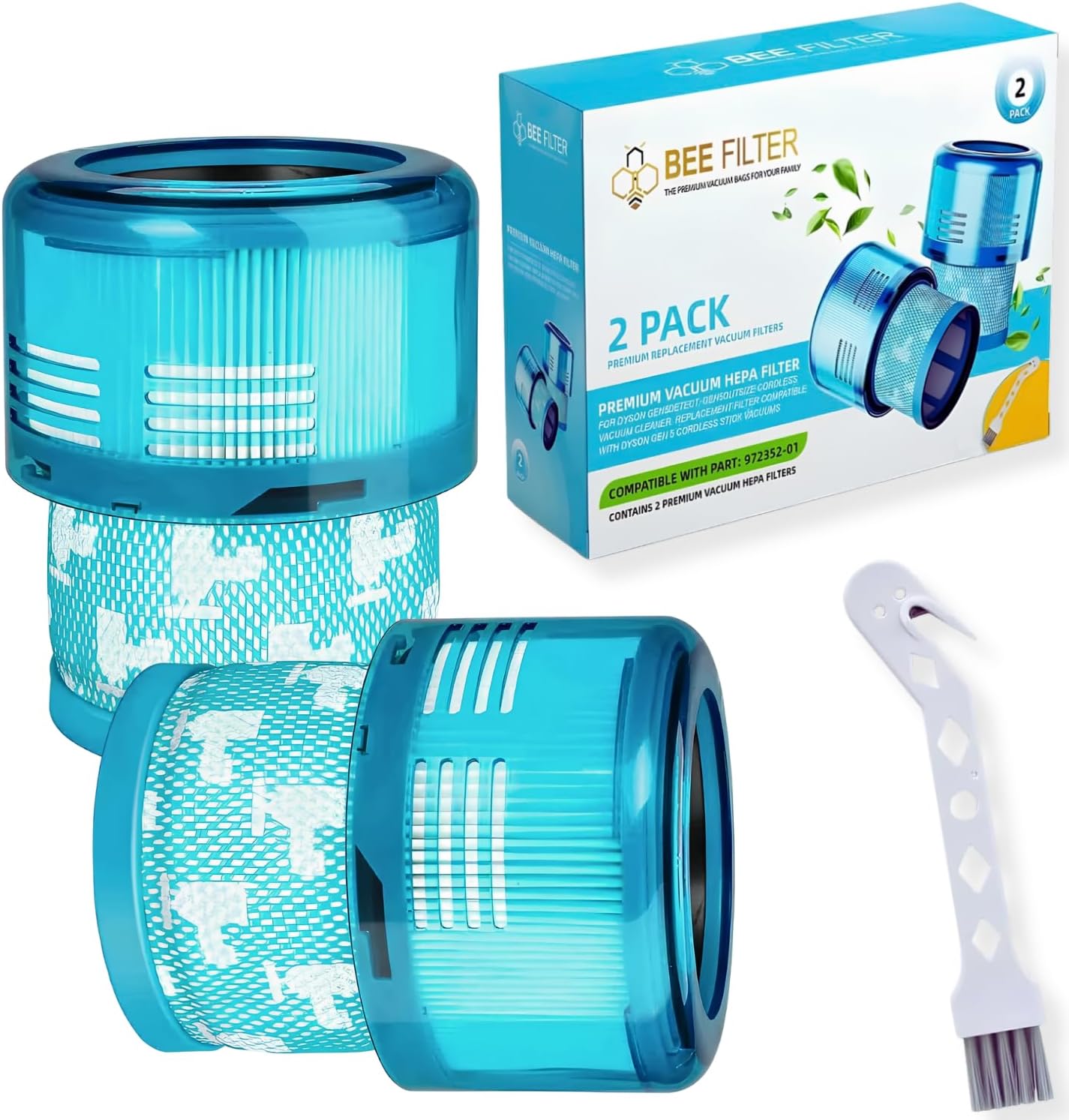
HEPA is one of the most visible terms in replacement vacuum filter shopping, and one of the easiest to read too broadly. It can appear in a title, an illustration, a description of filter media or a statement about a complete vacuum. Those uses do not automatically mean the same thing. To make a useful decision, identify exactly what the statement describes and what evidence supports it.
This guide explains how to evaluate the language. It does not assign a certified filtration grade to Bee Filter products, promise a health outcome or claim equivalence with a genuine Dyson filter. If a particular performance level is essential to your purchase, request documentation tied to that exact replacement item before relying on the claim.
Bee Filter’s HEPA H13 material specification
Bee Filter describes its replacement-filter range as using premium HEPA H13 media, with up to 99.99% filtration of airborne dust, an ABS housing and washable, reusable construction. The H13 designation and percentage are specifications supplied by the brand owner for the filter material. The supplied information does not identify a particle size, test method or independent report for the finished replacement assembly. It also does not establish a whole-vacuum efficiency figure after installation.
This distinction lets a product description be both useful and precise: HEPA H13 media is the featured material, ABS is the stated housing material, and washability is a stated care feature. The up to 99.99% figure should stay attached to the brand’s media specification. It should not be expanded into a promise to capture every particle size at that rate, a claim of H14 classification, or a claim that the complete machine has been independently certified. H13 and a percentage are not interchangeable descriptions of a test.
Understand the role of the material and the assembly
The filtration layers provide the working medium through which air passes. Their arrangement within the assembly, the condition of the media, the fit of the housing and the installation all matter to how a replacement functions in use. Bee Filter’s material description does not specify a universal layer count, coating recipe or adhesive system, so those details should not be guessed from a photograph. A neat-looking exterior is useful for checking the supplied item, but it cannot reveal every internal construction detail.
The ABS housing is a separate part of this construction story. It supports the assembly and gives the user surfaces to hold while removing, checking and refitting the filter. The presence of ABS is not itself a particle-capture result and does not establish an impact rating or unlimited service life. Treat the housing and filter layers as parts to inspect together: damage to either can be a reason to stop using the assembly, even if its original material specification was suitable.
Washable design is a practical ownership benefit
A washable Bee Filter HEPA Filter is intended to be maintained and reused while it remains sound. Follow the supplied washing instructions, handle the media gently and let the entire assembly dry completely before reinstalling it. A dry spare makes this easier to plan. Reusability does not mean the media is permanent, that a fixed number of wash cycles has been verified, or that any cleaning chemical is suitable. It means the product offers a care route beyond simply discarding an otherwise serviceable filter after normal dust loading.
What HEPA means in a general definition
The U.S. Environmental Protection Agency describes HEPA as high efficiency particulate air filtration and explains the commonly cited benchmark of at least 99.97 percent removal at 0.3 microns. The EPA also explains that this particle size represents a difficult capture range, rather than a rule that smaller particles simply pass through. That is general educational information about the term, not a test result for an individual vacuum filter.
A product still needs its own applicable evidence. Reading a recognized definition establishes what a claim is trying to communicate; it does not establish that a particular replacement has been tested to that definition. Keep these two questions separate while comparing listings: what does the term mean, and what is known about this exact item?
Identify the subject of the claim
| The claim describes | What to ask next |
|---|---|
| A filter material sample | Does the document identify only the material, or the finished replacement assembly? |
| A complete filter assembly | Is the tested assembly the same product and revision offered for sale? |
| An entire vacuum cleaner | Which machine, installed filter and test configuration were evaluated? |
| A family of replacement products | Which individual products are covered, and where is that coverage documented? |
These distinctions matter because a replacement is more than a label on packaging. A buyer needs to know whether a statement concerns a material, a component or the finished system. Do not silently move a result from one level to another. If the wording never identifies the tested item, ask for clarification instead of treating an impressive percentage as a complete answer.
Read a report from the product identity outward
Start with the product name, model or sample identifier in the document. Compare it with the seller’s item code and ask how the two are connected. Then look for the report date, laboratory identity, stated test method, measured results and any limits on the conclusion. A report is most helpful when you can follow the connection from the item in your basket to the item described in the evidence.
A photograph of a certificate or a cropped results table may omit that connection. Ask for a legible document with the relevant identifying information included. A report about another type of appliance filter, another supplier’s material or an earlier design is not automatically proof for the current vacuum replacement. This is a documentation question, not a reason to infer either good or poor performance without data.
Understand what a part reference does and does not prove
A reference such as 972352-01 helps identify the original replacement application. Dyson’s official page uses that number for a filter associated with listed Gen5detect and Gen5outsize machines. Bee Filter’s Gen5 replacement two-pack uses a comparison reference to help customers find its intended application. The original part’s performance statements remain statements about the original product.
Compatibility information is therefore one line in your comparison, and filtration documentation is another. A shared reference cannot be used to copy a manufacturer’s efficiency claim across brands. Similarly, a compatible filter that visually resembles an original one has not, through appearance alone, demonstrated the same measured performance. Use the part number guide for identification and keep performance questions separate.
Do not turn HEPA, H13 and H14 into interchangeable badges
Shoppers may see several grade labels next to the same product. Rather than trying to rank the product from the largest number on the page, ask which classification system is being cited and which report establishes the stated class. A listing should explain its own terminology clearly enough that a customer does not need to guess whether the labels refer to the material or to the completed filter.
Bee Filter supplies H13 as its media specification. This guide reports that brand-stated designation without presenting it as independent certification or relabeling it H14. If a particular independently verified classification is a firm purchasing requirement, request the applicable product-linked documentation and check the classification and test conditions it actually covers.
Keep everyday observations in their proper place
A filter that installs neatly, a vacuum that starts normally and a customer who likes the cleaning result can all provide useful practical observations. None is a laboratory measurement of particle capture. A photograph of dusty filter media shows that the component has encountered dirt; it does not calculate the percentage captured or characterize what left the machine.
The same discipline applies to customer reviews. Use them to understand the reported model fit, the buying experience and the care routine. Do not treat a phrase such as cleaner air as a quantified result. When comparing products, record measurable claims in one part of your notes and subjective owner comments in another. Both can inform a purchase, but they should not be presented as equivalent forms of evidence.
Washability and filtration grade answer different questions
Washable describes a care characteristic. HEPA and grade terminology describe filtration claims. Neither word, by itself, tells you everything about the other. Follow the instructions supplied for the actual replacement assembly, and do not infer that an item can tolerate a cleaning method simply because another filter with a similar grade can be cleaned that way.
Before buying a spare, check how the seller tells you to clean it, when it may be reinstalled and what signs call for replacement. A planned maintenance routine should leave time for the required drying process. Our filter washing guide helps organize the routine, while the instructions for your machine and filter remain the reference for their specific care requirements.
Recognize claims that go beyond the available information
A filtration label should not be stretched into a promise that the entire home becomes sterile, that all odors disappear or that a household health condition will improve. Those are different claims requiring different evidence. For routine shopping, keep the question tied to the product you are choosing: its stated application, its documented characteristics and its care requirements.
Also be cautious about comparisons that use a number without its context. Two percentages shown side by side may refer to different particle sizes, different tests or different products. Write down the conditions next to the number. If the conditions cannot be found, a direct ranking may be less informative than it first appears. Strong-looking typography does not resolve missing comparison details.
A clear message to send before purchase
You can ask a seller: I am considering this exact product for my named vacuum model. Does the filtration statement apply to the complete replacement assembly, and can you provide the corresponding report or documentation? Please identify the test method, sample reference and product connection. This gives the seller a specific request and gives you an answer that can be compared with your requirements.
For a Bee Filter item such as the purple V15/V11 two-pack, include the ASIN in the message so the discussion concerns that variant. Do not use a response about a different color, pack or filter family as automatic confirmation. Keep any supporting document alongside the order information for future reference.
Choose with the evidence you actually have
Begin with verified fit. Next decide which performance characteristics matter to you and whether the product-specific documentation addresses them. Then consider care, pack size, price and support. This order makes the HEPA label one useful part of a decision rather than a substitute for the decision itself. For a broader comparison, see genuine versus compatible Dyson filters.
Sources and further reading
Model-specific manufacturer instructions take priority. Product options refer to the Bee Filter catalog reviewed on October 16, 2026.